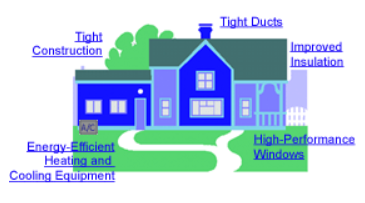
Reducing household energy consumption is largely a sequencing problem. The same set of upgrades applied in a different order can yield substantially different results — not because the physics changes, but because improvements interact with each other in ways that affect what makes sense to do next. A new high-efficiency furnace installed in a poorly sealed house, for example, will run more efficiently than the old one but still far below its rated capacity, because the heat it produces escapes before reaching the intended spaces.
This reference outlines a general framework for approaching energy improvements in Canadian residential buildings, with notes on where the data tends to be most consistent and where local variation matters most.
The Envelope First Principle
Building science literature from both NRCan and the Passive House Institute consistently places thermal envelope improvements — insulation, air sealing, and window upgrades — before mechanical system replacements in the upgrade sequence. The reasoning is straightforward: every dollar invested in reducing heat loss means the heating system needs to produce less heat. A house with adequate insulation and air sealing can operate with a smaller, less expensive heating unit at a lower operating cost than the same house with a larger, more efficient unit but persistent heat loss.
The practical implication is that if a furnace is approaching end of life and the attic is also underinsulated, addressing the attic before or concurrent with the furnace replacement allows sizing the new unit correctly for the improved envelope, rather than for the current heat loss rate.
Priority Order: Where Returns Tend to Be Highest
The following ranking reflects average cost-effectiveness across Canadian climate Zones 5 through 7, which cover the majority of the population. Zone 4 (coastal BC) and Zones 7–8 will shift some priorities. An energy audit provides house-specific data.
1. Attic Air Sealing and Insulation
The combination of sealing bypasses at partition walls, plumbing chases, and the attic hatch followed by bringing insulation to current code depth has the highest consistent return of any residential upgrade in cold climates. Cost of materials is relatively low, labour requirements are modest, and the impact on heating demand is immediate and measurable. Payback periods in Zones 6 and 7 typically run 4 to 8 years for a full retrofit from R-20 to R-60.
2. Window and Door Weatherstripping
Weatherstripping and caulking around windows, doors, and penetrations ranks second on a cost-per-unit-of-energy-saved basis. The total material cost for a 1,500 square foot house is typically under $200. Labour, if hired out, adds to this but rarely makes the upgrade unprofitable over a 3-to-5-year horizon.
3. Basement and Crawlspace Insulation
Uninsulated basements in Zone 5 and above represent a substantial and frequently overlooked loss pathway. Heat conducted through the foundation walls and floor slab accounts for 15 to 25 percent of total heat loss in a typical detached house. Insulating the interior face of basement walls with rigid foam board or a stud wall with fibreglass batts behind a vapour barrier is achievable as a DIY project, though it requires careful attention to moisture management — improperly detailed basement insulation can trap moisture and damage the wall assembly.
4. Heating System Efficiency
Once the envelope is addressed, heating system efficiency becomes the next productive target. The key metric is AFUE (Annual Fuel Utilization Efficiency) for gas or oil furnaces, with current high-efficiency models rated at 95 to 98 percent AFUE compared to 60 to 70 percent for units from the 1980s. The savings from the efficiency gain depend heavily on how much heating the system needs to do — which is determined by the envelope work described above.
Heat pumps, both air-source and ground-source, are increasingly viable in Canadian climates as cold-climate rated equipment has improved. Air-source heat pumps rated for operation at –25°C are available from several manufacturers and qualify for provincial rebates in British Columbia, Quebec, and Ontario. The economics depend on local electricity and natural gas pricing, which vary significantly across provinces.
5. Water Heating
Domestic hot water typically represents 15 to 20 percent of total household energy use. Replacing a tank-based electric water heater with a heat pump water heater reduces energy consumption for that function by 60 to 70 percent in most installations. In cold climates, the heat pump water heater draws heat from the surrounding air — which works well in a conditioned basement but less effectively in an unheated garage or cold crawlspace.
Federal and Provincial Incentive Programs
Several programs currently provide financial support for residential energy upgrades in Canada. Program availability and grant amounts change with government budget cycles; the figures below reflect the 2026 status as of the date of publication.
| Program | Scope | Max Grant (CAD) | Requirement |
|---|---|---|---|
| Canada Greener Homes Grant | Federal | $5,000 | Pre/post EnerGuide audit required |
| BC Hydro Home Efficiency Rebates | British Columbia | Varies by upgrade | Licensed contractor installation |
| Enbridge Home Efficiency Rebate Plus | Ontario | Up to $10,000 | Pre-retrofit audit required |
| Rénoclimat | Quebec | Varies by upgrade | Approved evaluator assessment |
| Energy Efficiency Alberta | Alberta | Program closed 2020 | N/A |
Reading an Energy Audit Report
A home energy audit delivered through the Canada Greener Homes program produces an EnerGuide rating expressed in gigajoules of energy consumed per year. Lower numbers are better. A typical Canadian house built in the 1970s scores between 200 and 300 GJ/year. A house that meets current building codes typically scores 80 to 130 GJ/year. The audit also provides a recommendation report listing measures by estimated cost-effectiveness.
The recommendation report distinguishes between measures with short payback periods (typically air sealing and insulation) and those with longer horizons (window replacement, heat pump installation). For homeowners working with a fixed budget, the air sealing and insulation measures typically deliver the highest fraction of total possible improvement per dollar spent.
Realistic Expectations
A complete retrofit addressing the attic, basement, windows, and heating system in a Zone 6 house built in 1975 can reduce annual heating energy consumption by 50 to 65 percent. That range reflects real variation in starting conditions, retrofit quality, occupant behaviour, and weather. A single measure — adding attic insulation without addressing other losses — typically produces a more modest but still meaningful result, in the range of 10 to 20 percent for heating specifically.
NRCan data from the Residential End-Use Model indicates that space heating accounts for 63 percent of total energy use in Canadian homes on average, making it the dominant target for efficiency improvement across all climate zones.
More information on whole-home upgrade planning and auditor referrals is available through Natural Resources Canada's Canada Greener Homes Initiative.